Cork

The Douro River at Vila Nova de Gaia, the town in Northern Portugal in which all the port lodges are located. Oporto is on the opposite (north) side of the river. The port barges are no longer used to transport the barrels of port from the Douro to the lodges. Took this Thanksgiving, 2001. The bottle is port from the quinta of our cork producer, Norcor. It is a 1985 private reserve (they do not sell their port). This port is treated as a 'vintage' (ages in bottle) but a true vintage must be submitted to the Port Wine Institute to receive the designation. By the way, the bar at the Port Wine Institute (Solares do Vinho do Porto) is worth the trip to Portugal by itself. A few hundred ports to sample in a quiet and comfortable (sofas) setting, inexpensive, located in about a 1000 year old building/museum overlooking the Douro River. Olives, cheese, nuts, crackers ("salted cookies"), chocolate torte, ~15 samples and a cab ride.

Natural Cork from Portugal
We have been importing natural cork from Norcor of Portugal since 2001. Norcor produces over 150 million corks annually from a state-of-the-art facility operating under strict sanitary codes.

  • Ozone, ethanol, and SO2 treatment processes to ensure against taint
  • Peroxide washed for sterility. No chlorine
  • Surface treatment (paraffin and silicone) for easy corking and better seal
  • Cork packed in sterile SO2 filled bags
  • All corks pass a final vast inspection plan through four in-house laboratories
  • Technical Report containing laboratory results for each lot
  • Norcor is certified by Systecode (The Cork Industry Manufacturer's Code of Good Practice)
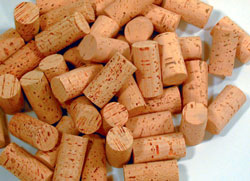
How are corks made? Click here for photo tour of Norcor from 2001.

Sophisticated treatment processes using Ethanol, SO2, and Ozone to ensure against taint.

Corks are packaged in bags of 1000 with SO2 gas. Be careful when opening to avoid inhaling the gas.

Norcor is certified by the Systecode (The Cork Industry Manufacturer's Code of Good Practice) which is audited gby the Bureau Veritas, the international independent quality audiors. Norcor is also certified to ISO 9001:2000 standard. . Click here for certification documents.

Four separate in-house laboratories for physical, chemical, microbiological, and sensory analysis. The final test procedure is extensive with every quality attribute of the finished cork subjected to stringent laboratory analysis. Each result is statistically measured. A certificate of conformity is issued for each batch.

Corks are stored in a variety of solvents for chemical, microbiological, and sensory analysis.

Quality Control Report include quantitative statistical results of Moisture Content, Dimensions, Residual Oxidants, Surface Treatment, and Sensory Analysis. Click here for larger pdf view. of an example report or report on Plastic Tops.

Natural Corks from Norcor of Portugal

Grades of Cork
There are several grades of cork. We stock Flor which is the best quality, and 1st which has been the best selling for us and is a good quality cork for most wines.


  • Flor
  • Extra
  • Superior
  • 1st
  • 2nd
  • 3rd
  • 4th
  • Agglomerated
  • Colmated
Diameter
Length
Grade
250
1000
5000
24 mm
1.93" (49 mm)
Flor
---
$450 per 800
$1975 per 4000
24 mm
1.77" (45 mm)
Flor
$150
$525
$2325
24 mm
1.77" (45 mm)
First
$66
$220
$970

Corks for Belgian-style ales. 23.5 mm fits American champagne bottle with 16.5 mm opening. (This bottle will accept a standard 26 mm American crown.) 25.5 mm fits bottle with 18.5 mm opening. For example, Duvel, Chimay, Unibroue bottles. To be sure, simply send us a bottle or measure the bottle opening with calipers.

~16-19 mm of cork should be left outside the bottle.

We also offer SemiAutomatic Corking Machines for Champagne/Belgian Beer and Wirehood Spinning Machines. In addition, the Champagne Foil Applicator does a beautiful job finishing Belgian beers.

Please note: Do not use either of these corks for champagne. Champagne cork has solid disc end with agglomerated top, and must be larger diameter than either of these cork.

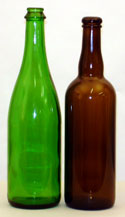
The green bottle on left takes 23.5 mm cork.
The brown bottle takes 25.5 mm cork.
23.5 mm
see green bottle in photo
Micro-Agglomerated
for Belgian beers--green bottle in photo
$55 per 250
175 per 1000
----
25.5 mm
see brown (Chimay) bottle in photo
Micro-Agglomerated
for Belgian beers--brown bottle in photo
----
$155 per 800 o/s
----

Wirehoods for Belgian-beer $290 box of 2700
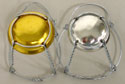
26.5 mm. Silver plaque with silver legs. Mushroom corks for beer require a smaller wirehood than champagne corks. These 26.5 mm beer wirehoods are not stocked by wirehood distributors in America, simply not enough demand.

Photo compares 26.5 mm wirehood for beer (Silver plaque) to larger champagne wirehood (gold plaque).

As a rule of thumb, the cork should be 6 mm larger than the bottle opening for still wine, 7 mm for beer and low carbonation wines, and even larger for champagne. Of course, there are many variations due to non-straight bottle necks.
    'Flor' cork on the right with lower quality cork on left. These were sorted by machine at our cork producer. The 'Flor' cork was one of three out of nearly 20,000 in this particular lot. Click here for photo tour of cork production.

  • The quality of natural cork depends upon density. The less pores in the cork, the more dense the cork and the better it is at sealing the wine from the outside.
  • Length is not very important in evaluating quality of corks. There is very little difference between the effectiveness of a 1.75" cork and a 2" cork in preserving wine. Long corks are chosen over shorter corks largely because of their asthetic appeal---the loud pop when you uncork the bottle is appealing.
  • There are 9 grades of wine corks based on the quality (quantity and size of pores) of the natural cork. They are Flor, Extra, Superior, 1st, 2nd, 3rd, 4th agglomerated, and colmated. 'Colmated' is made from the low grade cork and the pores are resin filled to give a smooth appearance. [The paraffin and silicone coating that all of our corks have is different from this resin filling.] They are fine for wines served quickly, up to a year or two. Agglomerated cork is cork granules that are held together by an special cork epoxy. All champagne corks are agglomerated because they are large in diameter and the cost of producing such large diameter solid cork is prohibitive.
  • Peroxide washing--no chlorine. Chlorine-washed corks are known to cause off flavors. All of our corks are peroxide washed for sterility and no off flavors. No need to sanitize.
  • Do not soak or heat our corks before use. Our corks have a surface treatment of emulsion with paraffin and silicone which makes bottling easier. Heat and water remove this coating.
  • Please note that cork treatment (ozone, ethanol and SO2 treatment, peroxide wash, SO2 packaging, paraffin/silicone coating) is equally important to grade in assessing cork quality.

Comparison of cork types. From left to right in photo. First Quality, Colmated and MicroAgglomerated. [Champagne corks are also agglomerated but the particle sizes are larger.]


Important Information for Natural Cork Use
1. Store corks at ~70 F for at least 24 hours before use.
2. Bottles should be left upright at ~70 F for a minumum of 2 hours after corking.
3. Fill level. There should be 15 mm of headspace between the bottom of the cork and the wine.
4. Do not moisten (soak) or heat these corks before use. They have surface treatment for easy corking and soaking removes the coating.
5. Bottling temperature should not exceed 60° C.
6. Internal bottle neck diameter should be minimum of 6 mm less than cork diameter for still wine, 7 mm for sparkling wine up to 1.5 bar pressure.
A cork is compressed a great deal during corking. For example, a 24 mm diameter cork is compressed to 16 mm (and then expands to 18 mm, the diameter of the opening in the bottle). The bottle is sealed tightly as the cork relaxes from this compression. The relaxation does not happen instantly---it typically takes about 3 hours to reach 95% expansion and up to 24 hours for full expansion in the neck of the bottle. If the cork is cold, the cork looses its elasticity and will not relax properly. If you lay a bottle down before the cork has fully expanded, wine can fill the space between the cork and the bottle, causing a poor seal including possibly leakage.

Notes for Synthetic Cork use
The above rules apply to synthetic corks. However, synthetic corks are generally less forgiving and can cause more problems with less professional corkers, cold temperatures, temperature fluctuations.

Destemming grapes in the Texas Hill Country, August, 1995, -hot!