Parts for Wine Tanks

On this page


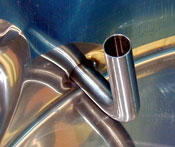
Sprinkler of pump-over $350
Vane design cannot plug.
1.5" Triclamp inlet.
Note that this is included with all the Letina closed top red fermenters (VIK tanks).

Complete N2 System for Closed-Top Wine Tank $1050 in stock
Does NOT include N2 cylinder

All components (except gas cylinder) needed to keep wine under N2 blanket. Simply attach the system to 2" TriClamp ferrule on top of tank.

Wine tanks cannot be safely pressurized above ~2 psi. This system permits safe pressurization of wine tanks at ~0.5 psi.

  • N2 Vent
  • Ultra-Low Pressure N2 Regulator---you must use an Ultra-Low Pressure N2 regulator. [Standard N2 regulators cannot operate at the low pressure required.]
  • Valves and Fittings.
    • Push-In valve and fittings for easy setup and gas-tight connections.
    • 2" TriClamp 90° Elbow, two 2" TC clamps and gaskets to connect to 2" TrClamp port on tank.
  • Tubing: Includes 100' of tubing. Cut to desired length.
  • N2 cylinder NOT included---obtain a cylinder from your local gas supply.

Easy to add tanks to the system. One regulator can handle many tanks. One N2 Vent can handle several tanks. Contact us with number of tanks, and distance between tanks, and we can setup complete system. As an example, a complete system for 6 tanks (one regulator and one N2 vent) will be ~$1750. A complete system for 3 tanks is ~$1400.

Click here for maintanence and setup prodecure.


Please note that the system does not include N2 cylinder. It is best to get these from your local gas supplier.

Double Acton Vent attaches to 2" TC port on top of tank thru 90° elbow. N2 line connects to push-in fitting.
Components of N2 system

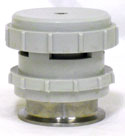
N2 Vent for Wine Tanks $240 in stock
1 psi Pressure Vent

Store wine under N2 blanket.

  • Pressure vents at 1 psi
  • Vaccum break at 0.05 psi
  • Maximum air flow rate is 125 GPM.
  • Gas inlet port 1/8" FNPT (not shown in photo)
  • 304 stainless steel.
  • Must be mounted vertically as in photo.
  • 2" TriClamp How to Determine TriClamp Size

Note the 3 ports. Top is pressure relief. Bottom is vacuum break (this is elevated when in use). Side port connects to tank---typically through an elbow. [There is a 4th port for N2 gas line not shown in this photo, but can be seen in photo of system above).

Do NOT pump out tank, or fill tank, at greater than 125 GPM (unless you remove the N2 Vent or open top hatch of the tank).

Click here for maintanence and setup prodecure.

Components

  • Push-In Fittings
    • Male Connector 1/4" MPT x 1/4" tube $4.50
      on regulator
    • Mini-Valve (1/4" tube x 1/4" tube) $30
      on regulator
    • Male Swivel 90° Elbow. 1/8" MPT x 1/4" tube $6
      on N2 Vent
    • Y Connector. (tube to tube 1/4") $7
      use this if you add a tank.
    • Plug for Push-In Fitting 1/4" $2
    • Plug for Push-In Fitting 1/2" $2.50
    • Male Swivel 90° Elbow. 1/2" MPT x 1/2" tube $12
      Used to connect additional tanks to one N2 Vent.
    • 1/2" MPT x 1/2"tube x1/2"tube TEE $18
      Used to connect additional tanks to one N2 Vent.

How to Use Push-In Fittings
To connect tubing: Simply push the tubing into the fitting.
To Disconnect. Depress outer sleeve of fitting and pull tubing out.

  • Tubing.
    • 1/4" LDPE for Push-In fittings. $15/100' roll
      1/4" tubing connects regulator to N2 Vent.
    • 1/2" LDPE for Push-In fittings. $35/100' roll
      1/2" tubing connects two tanks to one N2 Vent
      .
  • TriClamp Fittings---see sanitary fittings page

Easy to add tanks to the system. One regulator can handle many tanks. One N2 Vent can handle at least up to 4 tanks. Contact us with number of tanks, and distance between tanks, fittings on lid or top of the tanks, and we can setup complete system.

Ultra-Low Pressure N2 Regulators

These regulators are designed for wine tanks in which the pressure MUST be regulated at very low pressure. Maximum pressure is 3 psi and the pressure can be precisely regulated to 0.3 psi.

Wine tanks are neither fabricated nor certified to withstand pressures in excess of a few psi. Standard single-stage N2 regulators should NEVER be used to pressurize wine tanks because the upper pressure limit is too high. Click here for standard single-stage N2 regulators.

In addition, tanks should have a safety release valve installed. The vent pressure should be 3 psi or less. [Please note that closed top tanks with a two-way air valve are fine because the air valve is a safety release valve.]

Low Pressure N2 Regulator--Tank mount $750

  • Pressure Regulation 0.3-3 psi
  • Attaches directly to N2 (or Argon) cylinder.
  • This is a two stage regulator. The first stage accepts pressure of the cylinder (as high as 3000 psi) and drops the pressure to ~40 psi. The second stage regulates the outlet pressure from 0.3-3 psi.
  • Flow 43 GPM
  • Outlet Valve included.

Regulators must be calibrated in the static phase.
Procedure to calibrate: Close the Outlet valve. Open the N2 cylinder valve. (The pressure reading will be inaccurate.) Open and close the Outlet valve. (The pressure reading is now accurate.)

Dual Scale on Gauge. mbar in red, and mm H2O is outer scale.
70 mbar ~ 1 psi. So typically set pressure to 40-50 mbar for wine tank.
Note that the N2 vent (at left) opens at 1 psi (70 mbar), so you must set the regulator below 70 mbar.

Replacement Gauges
Low Pressure $80
High Pressure $25

Low Pressure N2 Regulator--Wall mount $1195 in stock

  • 0.3-3 psi
  • Wall mounted. Run feed line directly from N2 (or Argon) cylinder to unit. Two inlets permit operating line and reserve. For large operations, place these units at 50' spacings to ensure proper pressurization along entire line of vessels.
  • This is a two stage regulator. The first stage accepts pressure of the cylinder ( as high as 3000 psi) and drops the pressure to ~40 psi. The second stage regulates the outlet pressure from 0.3-3 psi.
  • Outlet Valve included.
These regulators are intended to be used with Closed Top tanks.

Overview of Tank Vents
All of these vents are Double Action:

  • Vent under positive pressure inside the tank.
  • Vacuum break (let air/gas into tank when tank is drained)


White Plastic

Least expensive and most common vent for wine tanks.


Vent-211

Standard on our Letina tanks.

Better seal than White Plastic
Easy to remove and clean
The associated lid tube mitigates wine coming through.


N2

The best vent for wine.
Good seal.
The only vent for storing wine under Nitrogen.

Closed Top tank only.


Beer

For certified pressure-tested tanks only.

Material
White Plastic
Grey Plastic
stainlesss steel
stainlesss steel
Seal
Marbles on plastic
Plastic on Plastic
silicone gasket
silicone gasket


White Plastic Vents
Most common and inexpensive.

  • Pressure vents at 0.05 psi
  • Vaccum break at 0.05 psi
  • Maximum gas flow rate is 57 GPM.
  • White plastic
  • Two marbles make seal against the plastic. One marble for vent, the other marble for vacuum.
  • Includes top, backing nut and gasket. Fits thru hole in lid, back nut secures it.

The max gas flow is important when pumping out the tank. Be sure the flow rate matches or exceeds the pump speed.

Fits opening of diameter
Price
Replacement rubber gasket
Number 1

1-3/4"

$9
$1.50
Number 2
1-9/16"

$9

$1.50
Number 2-Large
1-9/16"
max flow is greater, 110 GPM.

$9

$1.50

Vent-211 with 2" Triclamp $65
Includes the Vent-211 with stainless adapter to 2" TriClamp. Use this on tanks from other mfgs that have Triclamp port on top.

How to Determine TriClamp Size

Safety Vent for High Pressure Tank (BEER)
15 or 35 psi pressure release

10-15 psi Safety Vent $160
30-35 psi Safety Vent $160

  • Pressure vents at 15 or 35 psi
  • Vaccum break at 0.1 psi
  • Maximum air flow rate is 100 GPM.
  • 304 stainless steel.
  • 2" TriClamp How to Determine TriClamp Size

Extra Springs--Change a 15 psi Vent to a 35 psi by simply changing the spring.
15 psi spring $8
35 psi spring $8
These springs work only with St. Patrick's Safety Vents

This vent CANNOT be used on a wine tank. Wine tanks will be destroyed at pressures much lower than 15 psi.

The max gas flow is important when pumping out the tank. Be sure the flow rate matches or exceeds the pump speed.

The maximum pressure release is 15 and 35 psi respectively. This can be reduced to 10 and 30 psi by turning the top one turn counterclockwise. A 3/8" drive (for sockets) is required to make the adjustment.


Vent-211 $30
Replacement vent only for Letina tanks.

  • Standard on our Letina tanks.
  • Easy to remove and clean
  • Pressure vents at 0.05 psi
  • Vaccum break at 0.05 psi
  • Maximum gas flow rate is 125 GPM.
  • Threads onto stainless tube.
  • Grey plastic
  • Springs force the plastic/plastic seal.

[This vent cannot replace the White Plastic--you must have the associated stainless pipe welded to the tank lid. If you wish to retrofit a tank with this vent, you must weld a 2" Triclamp ferrule to the lid, then use the Vent-211 with 2" Triclamp above.]

The max gas flow is important when pumping out the tank. Be sure the flow rate matches or exceeds the pump speed.

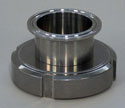
Adapter to replace Vent-211 with N2 system $45
Adapter to replace Vent-211 with N2 vent. This is NOT an adapter to put a Vent-211 on a 2" Triclamp port (that product is shown above). 304 stainless. Includes gasket. Remove the Vent-211, attach this adapter, and then attach the N2 Vent.
How to Determine TriClamp Size

Replacement rubber Gasket $4

Inflatable Gaskets
Instructions for Assembly of Floating Lid of Variable Capacity Tank

Determining Correct Gasket Size

  1. Measure inside diameter of tank in inches.
  2. Multiply by 2.54
  3. This is diameter in cm
  4. Choose matching diameter from table. [If diameter lies between two sizes, choose the smaller tube.]

Polyurethane gaskets may seem too small. They can stretch at least 10%.
It is easier to inflate (stretch) the gasket prior to putting on the lid.

Inflatable gaskets have 30 day warranty subject to normal use and service.

Pumps for Inflatable Gaskets

Periodic maintenance of pumps.
Remove the valve (black knob in photo) and lubricate orings and end seal.

Please note. Do not overtighten black knob---particularly if it has a teflon tip to make the seal. Teflon "cold-flows". This means it changes shape under pressure. Overtightening will change the shape of the teflon, making it harder to seal in the future.

Standard Pump $42

Pump with S/S Bracket $55
Large tanks may a bracket near the bottom the tank. This pump bolts to this bracket.

Replacement Gauge for Pump 1/4" NPT $10
Replacement Gauge for Pump 1/8" NPT $10
How to Determine Pipe Thread Size

Soft tubing--Air Pump to Inflatable Gasket $0.80/ft
5/16" ID.

Pumps for air tubes have 30 day warranty subject to normal use and service.

Silicone Replacement Gaskets for Manways and Hatches
Sizing Gaskets---Measure the inside diameter of the opening.
Gasket
Shape of Manway or Hatch
Size
Price
G22
Round
220 mm (9")
$14.50
G30
Round
300 mm (12")
$40
G40
Round
(also used on 16" Top Hatch of Letina tanks, N/250 )
400 mm (16")
$80
R1
Rectangular
310x420 mm
$22
R2
Rectangular
400x530 mm
$25
R3
Rectangular--Letina
440x560 mm
$75
O1
Oval-Letina
LCL
$55
T1
Top Hatch-Letina (T1/230)
200 mm
$30
T2
Top Hatch-Letina (T1/300)
300 mm

$55

Tube
Diameter
clear polyurethane
White Rubber
D40
40 cm
$25
D45
45 cm
$27
D50
50 cm
$34
D55
55 cm
$30
R60
60 cm
closeout $45
D60
60 cm
$32
D80
80 cm
$36
 
D95
95 cm
$40
D110
110 cm
$43
D140
140 cm
$38
D150
150 cm
$40
D160
160 cm
$56
D175
175 cm
$60
D190
190 cm
$65
 
Spray Balls


Revolving Spray Ball
$79 in stock

  • 1.5" Tri-Clamp connection.
  • 2 " Diameter ball.
  • 304 stainless.
  • Pressure: 30 psi
  • Flow: 50 GPM
  • Cleaning diameter: 8'

How to Determine TriClamp Size


Thru-Wall Revolving Spray Ball
These are placed through a TriClamp port on a tank.

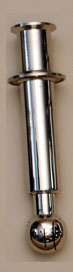
TWR Spray Ball 1.5"-2" $95 in stock

  • Fits 2" TriClamp port on tank.
  • Inlet is 1.5" Triclamp.
  • Ball diameter 1.75".
  • Total length 9.5"
  • 304 stainless.
  • Pressure: 30 psi
  • Flow: 50 GPM
  • Cleaning diameter: 8'

How to Determine TriClamp Size


Cleaning Head with Dual Nozzles
$125 in stock

  • Polished 304 Stainless Steel
  • 1" FPT connection (How to Determine Pipe Thread Size)
  • Heads spin in vertical plane while entire assembly spins in horizontal plane.
  • Pressure: 24-30 psi
  • Flow: 100 GPM.
  • Cleaning diameter:13'-20'

Note the correct orientation of the components. It is important that the all components rotate clockwise (as viewed from ends). 1)In top photo, note the position of the central part that spins in the horizontal plane. The two arms make an "S" as viewed from above. 2)See end view of nozzles in photo below. Note position and angle of the nozzles spraying to left and right. Both vertical rotating end units should look like this.


Maintenance of all spray balls. Lubricate periodically with food grade silicone spray. Be sure to rinse well with water after cleaning. Always lubricate after cleaning.
Pressure and Flow for Spray Balls:

  • Spray balls have a range of pressures/flows over which they operate effectively. The greater the pressure, the less flow is needed to maintain the same cleaning efficiency. However, there is an upper pressure limit. At excessively high pressures, the water turns to mist and is no longer effective.
  • City water pressure is often sufficient for rotating spray balls and barrel cleaning head. For example, our city water pressure is max 75 psi, and can supply 10+ GPM at 30 psi.

Sample Taps
304 stainless

1.5" TriClamp $25 |
upper left in photo
How to Determine TriClamp Size

1/2" MPT $30
upper right in photo
How to Determine Pipe Thread Size

Maintenance of sample taps. Periodically apply food grade grease to orings and sealing tip.

Please note. Do not overtighten sample valves---particularly if it has a teflon tip to make the seal. Teflon "cold-flows". This means it changes shape under pressure. Overtightening will change the shape of the teflon, making it harder to seal in the future.

Rotating Arm for TriClamp Valve
The original simple Rotating Arm—designed, manufacutred, and introduced to the wine industry by St. Pat's.
Allows you to drain up to 8" above or below the racking valve of the tank. It is also an answer to a tank with only one valve and the lees at the valve height.

  • Change a fixed height valve into a variable height valve
  • Drain tank from up to 8" above or below a racking valve
  • Drain tank from up to 8" above the lowest side wall valve.
  • Fittings to fit 1.5", 2", or 2.5" TriClamp
  • For new tanks or retrofit any tank
  • Simple to operate
  • True Stainless Steel Sanitary Fitting--high polish sanitary fitting designed by St. Pats
  • TC Clamp and Teflon Gasket included

The Rotating Arm is an independent fitting that is inserted between the butterfly valve and the tank ferrule. Prior to draining, loosen the TriClamp clamp slightly, rotate the Arm until the drain tube is above the lees, and retighten the clamp. The drain tube can be placed anywhere between 0" and 8" above or below the racking valve.

To operate: Loosen the clamp just a little to turn the arm. Then open the valve slightly while turning the arm until the juice is clear, and retighten clamp. You can now drain all the wine that is above the lees.
Leave the arm in the horizontal position when not in use to prevent lees from settling into the arm.

Please note there is a reduction in the output with the Rotating Arm in place. Each Triclamp size is effectively reduced by 1/2". For example, the RA250 will have the output of a standard 2" valve.
Please note rotating arms will NOT work on 100 and 150 liter tanks--diameter of these tanks is too small.

Rotating Arm
Fits tank with TriClamp Size
How to Determine TriClamp Size
Price
 
RA150 (includes 1.5" TC Clamp and teflon gasket)
1.5"
$56
RA200 (includes 2" TC Clamp and teflon gasket)
2"
$67
RA250 (includes 2.5" TC Clamp and teflon gasket)
2.5"
$79
Left photos show position of Rotating Arm (RA200) at same height as valve. Note handle on racking arm (outside of tank) is horizontal. Right photos show position of racking arm 8" above the valve. Note handle on racking arm (outside tank) is vertical. The arm can be easily rotated to any position between these two positions.

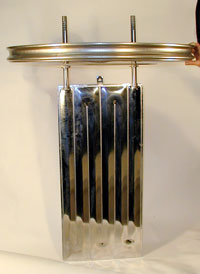
Cooling Plates for Wine Tanks

  • manufactured by Letina
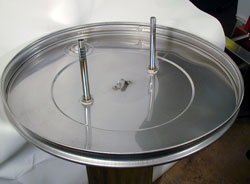
  • These plates are easily installed into lids of variable capacity tanks. No welding needed.
  • 304 stainless steel. Polished finish.
  • All plates sold complete with threaded coupling kit to easily attach plate to lid or any flat surface.
  • Maximum operating pressure is 1.5 bar (22 psi). [Plates are pressure tested to 12 bar (180 psi).]
  • Use 3/4" ID hose/tubing for chill lines.

Please note. The plates require a minimum of 4" plus the plate height. For example, the no. 12 plate needs 36" minimum of vertical space in the tank (4" + 32").
All of these plates will ship via UPS.


Plate mounts very easily with included kit. Stainless kit includes threaded couplings welded onto each inlet/outlet tubing along with nuts and rubber washers. You simply need to punch (or hole saw) 2 holes (11/8" diameter). We can punch the holes in a lid for $25.


Cooling Plate mounted in floating lid.
Plate
price
Cooling Plate Dimensions (height x width)
this is dimension of the rectangular cooling area.
recommended tank
Plate no. 01
drawing
$295 in stock. Please note that all of the remaining plates have 2 small dings in them. Cosmetic only, does not affect performance.
24" x 10.5"
300-600 liter
Plate no. 12
drawing
$325 in stock
32" x 15"
>600 liter
Labor charge for drilling holes in lid for Cooling Plate $30
Carbonation/Aeration Stones--Best designed stones in brewery/winery industry
St. Pats Gas Diffusion 'stones' and specialty fittings are uniquely designed for versatility and ease of use. In particular, they are the only stones with pipe threads, thus allowing facile adaptation to virtually all process systems.


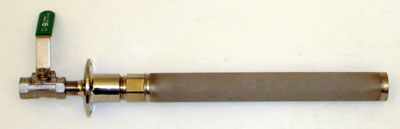
Inline Carbonation/Aeration Assembly $230
Complete with 1.5" TriClamp union, Stone II, and 1/4" ball valve. Photo above.

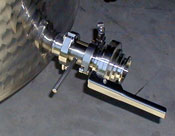
Inline Carbonation/Aeration Assembly w/ Standard Sight Glass $310
also includes TC Sight Glass, clamp and gasket. Lower left photo.

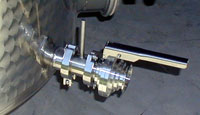
Inline Carbonation/Aeration Assembly w/ Clear Window $280
also includes Clear End Cap, Instrument Tee, clamps and gaskets. Lower right photo.

How to Determine TriClamp Size
How to Determine Pipe Thread Size


Tank Carbonation/Aeration Assembly-Large $280
Complete with 1.5" TriClamp coupler, Stone I, and 1/4" ball valve.

Tank Carbonation/Aeration Assembly SMALL $220
Complete with 1.5" TriClamp coupler, Stone II, and 1/4" ball valve.

St. Pat's design eliminates the leaks and assembly fuss of competitive stones. Competitive products either 1)weld the stone to an end cap which makes cleaning difficult and flexibility impossible or 2)press the stone between two gaskets which is prone to leaks.

How to Determine TriClamp Size
How to Determine Pipe Thread Size


Gas Diffusion Stones

Stone I $230
316 stainless, 2 micron porosity. 9.5" Length x 1" diameter. 1/2" MPT on one end, other end closed. Bottom in photo.

Stone II $170
316 stainless, 2 micron porosity. 4.75" Length x 1/2" diameter. 1/8" MPT on one end, other end closed. Center in photo.

How to Determine Pipe Thread Size

Special Fittings for Carbonation/Aeration Stones

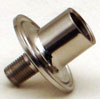
1.5" TriClamp Union with 1/4" MPT x 1/8" FPT $45 out of stock
1/4" MPT on outside and 1/8" FPT coaxial internal. This is fitting used for our inline gas diffusion stones. Stone II

1.5" TriClamp Coupler—1/4" MPT x 1/2" FPT $35
End Cap with 1/4" MPT on external face, 1/2" FPT on internal face. This is fitting used on our tank gas diffusion stones. Stone I

How to Determine TriClamp Size
How to Determine Pipe Thread Size
Bimetal Thermometer

304 stainless steel case, bezel, and stems. Reset screw for single point calibration. Dual scale (F an C). Accuracy is 1.5%.

Click here to understand NPT pipe thread sizes

Model
Face
Range
Stem
Back Connection
Price
Notes
T-1/4-250-4
3"
0-250 F
-20-120 C
4"

1/4" MPT

$12
1/4" stem diameter


Thermowells
304 Stainless Steel
Click here to understand NPT pipe thread sizes

Model
Stem Length
(accepts thermometer up to this stem length)
Price
Thermowell-3/4-18

3/4" Male NPT External Threads
(1/2" Female NPT internal threads)
This thermowell screws into 3/4" couplings. Use 1/2" NPT thermometers.

18"
$22

We set up the N2 systems in miniature----short lengths of tubing between components. This is to insure it will be very easy to understand how to put the system on your tank(s).

You simply need to replace the short lengths of tubing with appropriate lengths for your arrangement.

The tubing is connected with PUSH-IN FITTINGS. To release, depress the ring and pull out the tubing. Simply push the tubing in to connect.

Regulators must be calibrated in the static phase.

Procedure to calibrate: Close the Outlet valve. Open the N2 cylinder valve. (The pressure reading will be inaccurate.) Open and close the Outlet valve. (The pressure reading is now accurate.)

Dual Scale on Gauge. mbar in red, and mm H2O is outer scale
70 mbar ~ 1 psi. So typically set pressure to 40-50 mbar. Note that the N2 vent opens at 1 psi (70 mbar), so you must set the regulator below 70 mbar.

If you wish to understand how the vent works, I suggest the following.

  1. Put a 2" end cap on the side arm of the N2 vent. You will then have a very simple system of N2 regulator with valve and N2 vent only.
  2. Disconnect the tubing on the outlet side of the valve and calibrate the regulator as described above.
  3. Connect the tubing to the valve. Now adjust pressure slowly up to ~100 mbar. At around 70-80 mbar you will hear the gas escaping thru the top of the vent.
    Back the pressure off to ~50 mbar and it will hold pressure for a very long time--we have demonstrated that a K cylinder (50 L) will last literally 1000 years with this simple arrangement.

Maintenance of the N2 Vent.
The N2 vent has a simple design that will operate flawlessly for a very long time. There are no springs or complicated seals so it is easy to maintain.

  1. Periodically remove the top cover---it is simply a press fit over an oring.
  2. Remove the top seal with red silicone gasket. Clean surfaces and gasket with mild detergent cleaner. Lubricate with any non corrosive lubricant.
  3. To remove the bottom (vacuum) seal. Unthread the top part of the vent.
  4. The bottom seal has long thin rod---remove and clean silicone gasket as above.

Two-stage regulators are intended to be used with Closed Top tanks, but not with Variable Capacity tanks.

The top hatch on closed top tanks can be tightly secured with the rubber gasket and latches. The tank can then be pressurized with N2 and sealed tightly. N2 should not be used with Variable Capacity tanks, aka tanks with Floating lids. The Floating lid with inflatable gasket is not designed to allow the tank to be pressurized. Furthermore, the Floating lid rests directly on the wine, with no headspace, thus negating the need for N2. Ironically, installing a N2 system on a Floating lid tank will almost certainly increase, not decrease, the oxidation of the wine. All N2 cylinders have small amounts of O2. Every time N2 is introduced, a small amount of O2 is also introduced. In a tightly sealed system (such as a Closed Top tank), the amount of N2 needed over time is very small (and thus the amount of O2 is very small). In this case, a nitrogen blanket is certainly useful in protecting the product from oxygen. On the other hand, a Floating Lid tank will not seal tightly under pressure. Thus the N2, and O2, introduced over time is much greater. In the extreme, you will oxidize your wine completely by continuously bubbling N2 through it---because N2 cylinders always contain a small amount of the limiting reagent O2.